

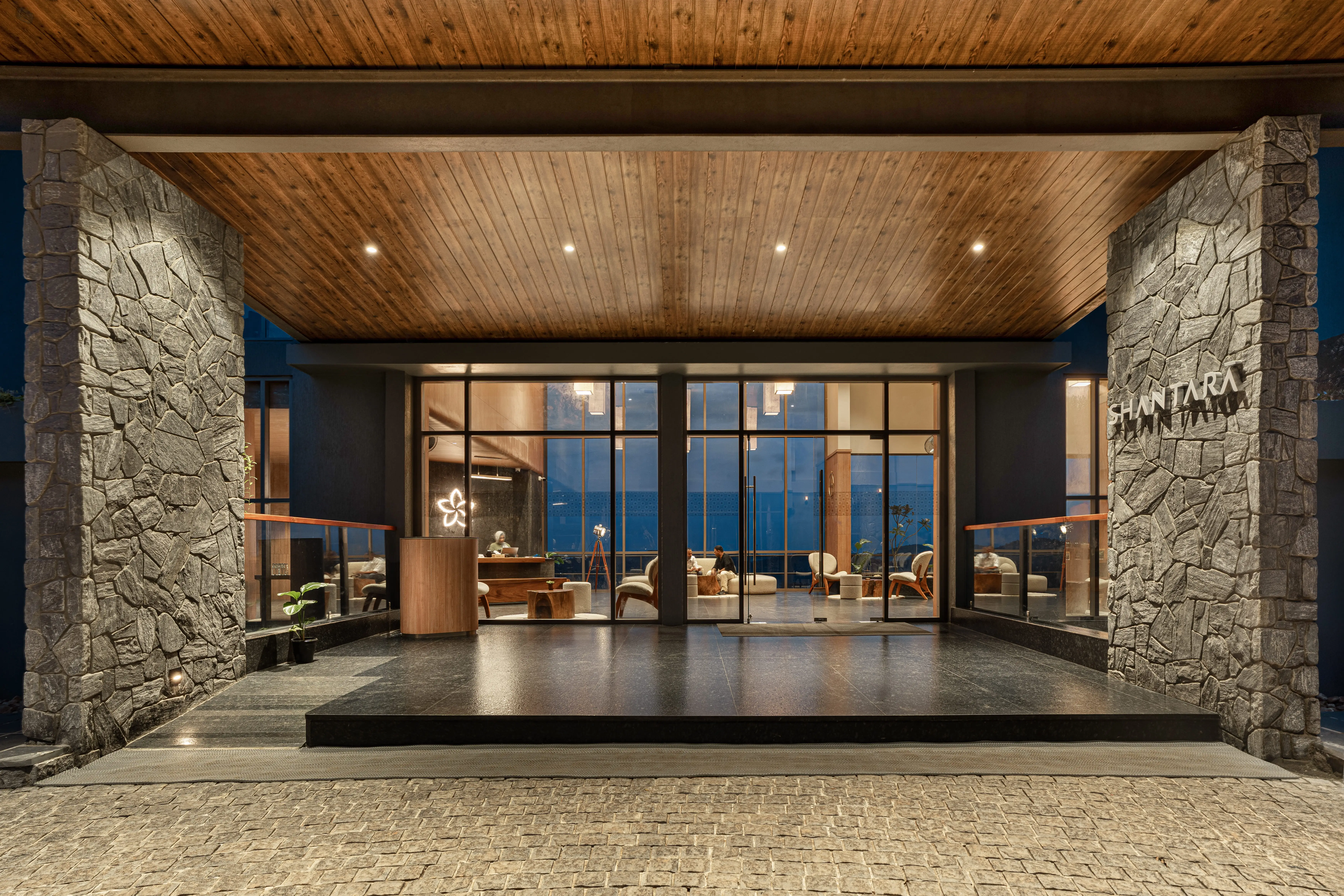
When Spunic began its engagement with Shantara Naturopathy Retreat in October 2025, the building was already nearing completion.
The promoters were not new to naturopathy. The project was built on the clinical legacy of Hygiene Nature Cure Clinic, with an established approach to naturopathy and lifestyle-based care.
But Shantara was a different proposition.
At 52 rooms, with extended wellness stays, food and beverage operations, recreational facilities and a significantly larger team, the new property could not operate simply as a larger version of the clinic.
The promoters recognised that gap. Their experience was predominantly clinical, while a project of this scale also needed hospitality operations, commercial planning, revenue strategy and a structured guest experience.
Spunic was brought in to provide that perspective.
The challenge was not to make Shantara less clinical. It was to build hospitality around its clinical foundation.
A nearly completed building, viewed through a different lens
One of Spunic’s first major interventions was a detailed Property Improvement Plan.
By this stage, substantial construction decisions had already been made. Redesigning the project from scratch was neither practical nor necessary.
Instead, the property was reviewed from two perspectives that had received less attention during its original planning: how a guest would experience the retreat and how the property would actually operate behind the scenes.
That review identified significant gaps.
Back-of-house areas for engineering, laundry, housekeeping, general stores, food and beverage stores, waste handling and staff support had not been adequately incorporated into the original design. The Property Improvement Plan proposed several interventions, including a separate service block for critical operational functions.
The guest rooms required attention too.
Several details expected during an extended hospitality stay had not been sufficiently considered, including bedside charging, workspaces, in-room safes, blackout curtains, emergency lighting, bathroom safety and communication facilities.
Not every recommendation in the PIP was implemented. That was not the objective.
The exercise gave management a hospitality-led assessment of an almost completed property, identified the gaps most likely to affect operations and guest experience, and helped prioritise what could realistically be changed before opening.
Building a kitchen around the operation
One area required more fundamental planning.
There was no workable commercial kitchen plan for the scale and operating model of the retreat.
At Shantara, food is not an ancillary hotel service. Guests staying for wellness programmes take their meals within the property, and food forms part of the overall programme and experience.
Spunic worked on the kitchen layout, equipment selection, production workflow, storage and food-safety requirements.
Restaurant capacity was also considered from an operational perspective. The Property Improvement Plan worked with a potential maximum occupancy of 110 people and recommended at least 60 dining seats after considering dining windows, clearing time and the more relaxed dining pattern expected in a retreat.
The principle extended beyond the kitchen:
The operation should determine how the space works, rather than forcing the operation to adapt to the building.
The reception desk that revealed the real challenge
One of the clearest examples of the transformation involved something seemingly simple: the reception.
The original lobby reflected a hospital operating model. Separate desks and counters were planned for reception, enquiries, payments and other functions.
To the promoters, this was familiar and logical. It reflected how they understood a healthcare facility to operate.
Spunic recommended eliminating the multiple counters and consolidating the entire arrival experience around a single hotel-style reception.
Management was sceptical.
The disagreement was not really about furniture or how many desks should sit in a lobby. It exposed two fundamentally different ways of thinking about the person entering the property.
In a conventional hospital environment, a patient arrives with a requirement and is directed towards the appropriate department or counter. Much of the service begins in response to something the patient asks for.
Hospitality reverses that relationship.
The property takes responsibility for the guest’s journey. The guest should not need to understand how the organisation is structured in order to receive service.
This was unfamiliar territory for an ownership team whose previous operating experience came from a clinical environment. Spunic held to the recommendation, and management ultimately agreed to implement it.
Once Shantara began operating, the concern proved unnecessary. The different functions did not need their own guest-facing counters. They could operate behind a single point of contact while the reception team coordinated the guest journey.
What initially appeared to ownership as removing necessary infrastructure instead made the arrival experience simpler.
That decision became representative of the larger transformation taking place throughout Shantara.
The objective was to move from a reactive hospital service model to proactive hospitality.
Arrival and departure rituals were introduced. Brand and service standards were developed. Employees were trained to anticipate requirements rather than waiting for every need to become a request.
The clinical experience remained at the centre of Shantara. What changed was the experience around it.
Building a commercially viable model
The same rethinking was required commercially.
The original business plan projected annual revenue reaching approximately ₹15 crore by year five.
Spunic’s feasibility work looked at the business from the operating model upwards. Market positioning, competitor benchmarking, manpower, operating costs, room categorisation, packages and revenue strategy were considered together rather than as separate decisions.
Affordability remained an important constraint.
Dr. P. A. Kareem, Founder, wanted naturopathy to remain accessible rather than create a wellness product intended only for a small luxury segment. The commercial strategy therefore had to support the scale and quality of the operation without losing sight of that vision.
Spunic developed the room naming, packages and broader revenue strategy around those requirements.
With the revised positioning and operating assumptions, the financial model showed a path towards approximately ₹25 crore in annual revenue at 80% occupancy, compared with the approximately ₹15 crore envisaged under the original five-year plan.
That change was not the result of one pricing decision.
It came from reconsidering the business as a whole: what Shantara would offer, how it would be positioned, how the property would operate, what organisation it required and what level of revenue that organisation needed to sustain itself.
The objective was to create an economic model in which the clinical programme, hospitality experience, operating costs and the founder’s affordability philosophy could coexist.
Creating one organisation from two disciplines
Shantara could not simply copy the organisation chart of a hotel.
It could not operate like a larger clinic either.
It needed both.
Spunic developed an organisational model with four divisions: Hospitality, Clinical, Commercial and Administrative.
Hospitality covered Front Office, Housekeeping, F&B Service, F&B Production and Maintenance. The Clinical division covered Consultation, Therapy, Nursing and Laboratory functions. Commercial included Sales and Marketing, while Finance and Human Resources sat within the Administrative division.
The separation created clear accountability.
Clinical decisions remained under medical leadership. Hospitality operations and the guest experience had their own leadership. Commercial and administrative functions supported both.
The structure was then translated into an actual team.
Spunic recruited Shantara’s department heads, including an Operations Manager with more than 20 years of hospitality experience and exposure to international hotel chains.
Manpower planning was linked to occupancy rather than assuming the fully mature organisation needed to exist from opening day.
| Occupancy | Planned headcount | Monthly CTC | Per occupied room night |
|---|---|---|---|
| 40% | 99 | ₹27.34 lakh | ₹4,382 |
| 60% | 122 | ₹32.70 lakh | ₹3,494 |
| 80% | 135 | ₹35.55 lakh | ₹2,848 |
The model gave management visibility into how staffing requirements and labour economics would change as occupancy grew.
More importantly, the manpower exercise demonstrated why staffing, commercial strategy and revenue planning had to be designed together rather than treated as separate pre-opening decisions.
Bringing clinical and hospitality cultures together
An organisation chart alone does not create hospitality.
Spunic developed the HR policy framework along with brand and service standards for the new operation. Pre-opening training was conducted for employees across the property, with separate sessions for the leadership team.
The challenge was unusual because two professional cultures had to coexist.
Shantara’s clinical team needed to retain the rigour, safety and treatment standards expected of a medically supervised naturopathy programme. Its hospitality team needed to create the warmth, anticipation and consistency expected of a retreat.
Dr. Bahja Janu, Medical Director, provided an important bridge between the two. Before joining the new retreat, she had spent more than 13 years with Hygiene Nature Cure Clinic and brought that clinical experience into Shantara’s new operating environment.
The aim was never to make clinicians behave like hoteliers or hospitality employees behave like clinicians.
It was to make both teams understand their roles in one guest journey.
Building the commercial machinery before opening
The work extended beyond operations.
Spunic planned Shantara’s website architecture and worked on the commercial foundations required to take the retreat to market. The consulting mandate covered competitor analysis, website and content strategy, photography and videography coordination, social media, SEO, paid search and content development.
Sales processes were developed around lead handling, consultation and bookings. CRM evaluation, group business, corporate sales and participation in relevant trade events also formed part of the pre-opening commercial scope.
The Shantara name itself was created by management, not Spunic.
Spunic’s role was to help translate management’s vision into a commercially viable positioning, operating model and guest experience.
A project built through different areas of expertise
Shantara’s transformation was not the work of a hospitality consultant in isolation.
It required management, clinical, construction and hospitality expertise to come together during the final stages of the project.
Nishan Kareem, Chief Executive Officer, represented the management side of that transition. His background in civil engineering, quantity surveying, construction and commercial management brought a strong technical and cost-management perspective as the project moved from construction towards operations.
Dr. Bahja Janu, Medical Director, led the clinical side, ensuring that the transition towards hospitality did not dilute the clinical standards and naturopathy principles on which the retreat was built.
Azhar Umar led the Spunic engagement as Chief Consultant, working with ownership and the Shantara leadership team across property improvement, commercial strategy, organisational design and pre-opening readiness. His hospitality background spans hotel operations, revenue management, sales, HR and finance, including pre-opening and repositioning work.
Construction and architectural execution were handled by Beyond Living, appointed directly by Shantara’s management.
Spunic’s role was not construction execution. It was to identify hospitality and operational requirements through the Property Improvement Plan and work with management and the project team to translate those requirements into the property wherever feasible.
Each party brought a different perspective to the project.
The management team held the vision and responsibility for the business. The clinical team protected the integrity of the naturopathy programme. The construction team translated physical requirements into the property. Spunic brought the hospitality, operating and commercial perspective that had been missing from the original hospital-led plan.
Opening was a milestone, not the end of the engagement
Shantara opened its doors on 1 August 2026.
By then, the project had moved considerably beyond the naturopathy hospital originally envisaged.
The property had been reviewed through a hospitality and operational lens. Critical guest-facing and back-of-house gaps had been identified and prioritised. A commercial kitchen had been planned. The commercial and revenue model had been rebuilt. Hospitality and clinical functions had been organised into a workable structure. Department heads had been recruited. Employees and leadership had been trained. Service standards, arrival and departure rituals and commercial processes had been established.
The engagement did not end when the doors opened.
Spunic continues to work alongside Shantara’s management through an 18-month post-opening engagement, allowing the systems and assumptions developed during pre-opening to be tested, refined and stabilised under actual operating conditions.
Long-term commercial performance will be measured as the property matures. For now, the opening marks the completion of the first part of the transformation.
From treating patients to hosting guests
The clearest measure of the transformation today is the difference between what the project was originally designed to be and what ultimately opened.
The clinical foundation remained.
What changed was the operating model around it: how guests arrive, how rooms function, how food is produced, how departments are structured, how people are trained, how service is delivered and how the economics of the property work.
A nearly completed naturopathy hospital opened as a hospitality-led wellness retreat.
Spunic’s role was not to make Shantara less clinical.
It was to make clinical wellness work as hospitality.
Building or repositioning a hospitality project?
Many of the decisions that determine whether a property works operationally are made before the first guest arrives.
Spunic works with owners on pre-opening, property improvement, commercial strategy and hospitality operations, from planning through opening and stabilisation.