

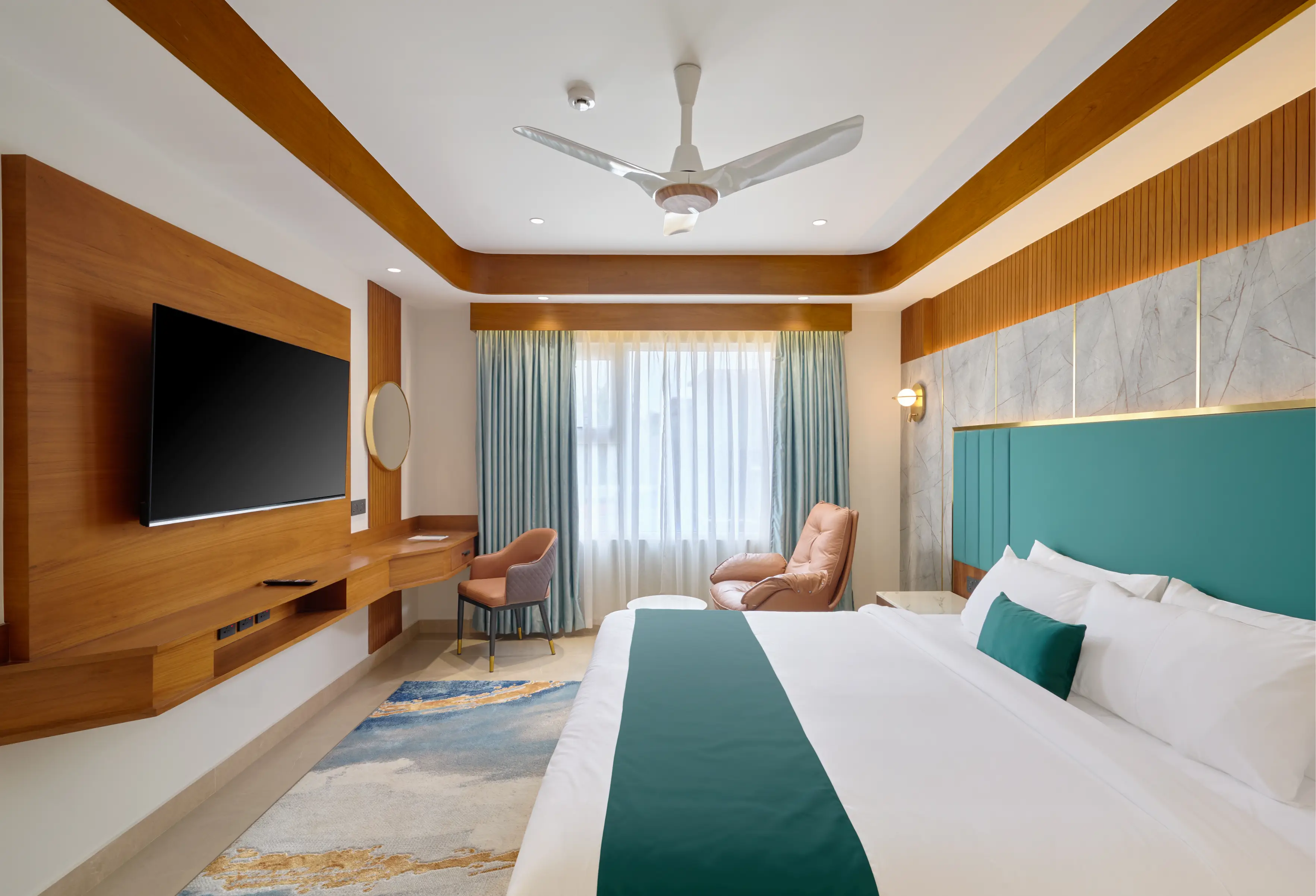
How Spunic helped first-time hotel owners reposition a nearly completed budget-hotel project, build a lean operating model and establish Kowju as a boutique hotel near Calicut International Airport.
When Spunic began working with the promoters of Kowju Airport Hotel Calicut in January 2024, the building was already largely constructed.
The owners were an established UAE-based business group with investments in real estate and commercial properties in Kerala. Hospitality, however, was new to them.
Kowju was their dream project.
The original plan was to develop a budget hotel close to Calicut International Airport, with the owners remaining closely involved in its day-to-day management.
Spunic saw a different opportunity.
The physical product and location had the potential to support a boutique airport hotel with a stronger guest experience and significantly better long-term commercial potential.
Realising that opportunity required more than changing the hotel’s positioning. The property needed an operating model, professional management, a commercial strategy and the systems required to give first-time owners visibility and control without requiring them to run the hotel themselves.
That became the assignment.
Repositioning the hotel before opening
The airport market already had accommodation.
Properties such as Tamarind KTDC, Kondotty, Malappuram, Atland Residency and Corridor Calicut Airport Hotel competed around the airport, alongside several smaller hotels and lodges. Current airport listings continue to show a market with a substantial number of relatively low-priced accommodation options.
Spunic’s recommendation was therefore not to make Kowju another entrant competing primarily as a budget airport room.
The property was repositioned as a boutique hotel near Calicut International Airport, with a better guest experience, stronger facilities and a professional operating model.
That decision shaped the rest of the engagement.
The consulting mandate covered property improvement, organisational design, recruitment, HR, sales and marketing, revenue management, hotel systems, SOPs, finance and management reporting, kitchen planning and pre-opening readiness.
The objective was not to make the hotel more complicated.
It was to identify where stronger standards could create value while keeping the underlying operation deliberately lean.
Making a nearly completed building work as a hotel
Spunic prepared a Property Improvement Plan after reviewing the nearly completed property from an operational and guest-experience perspective.
Rather than focus on minor architectural details, the exercise concentrated on the gaps that would affect the hotel once it began operating.
Guest rooms were reviewed for practical hospitality requirements. Back-of-house functions, housekeeping operations, accessibility, guest movement, luggage handling, banquet support, signage and other operational requirements were reconsidered before opening.
Architectural and civil execution was handled by Enviz Construction Consultants, appointed directly by Kowju’s management.
Spunic’s responsibility was different. The consulting team identified what the hotel needed from a hospitality and operational perspective and worked with management and the project team to incorporate those requirements wherever feasible.
The principle was simple:
A completed building is not necessarily an operationally ready hotel.
The restaurant decision management initially resisted
One of the most consequential disagreements during pre-opening concerned food and beverage.
Management initially considered outsourcing the restaurant operation.
On paper, outsourcing had obvious appeal for first-time hotel owners. It reduced the number of functions they had to operate themselves and transferred much of the complexity of food production, staffing and restaurant management to a third party.
Spunic strongly recommended against it.
The restaurant was too closely connected to the overall hotel experience to be treated as a separate business operating inside the property.
There was another commercial consideration.
Kowju also had the potential to develop its banquet and meeting business. Without control over its own kitchen and F&B operation, the hotel would have less control over food quality, service standards, banquet execution, guest recovery and the economics of events.
Management was initially reluctant to take on that complexity.
Spunic held to the recommendation.
The property did not yet have a workable commercial kitchen, so Spunic also worked on the kitchen planning, layout, equipment requirements and operational flow in coordination with the specialist project team.
The restaurant concept itself was kept deliberately focused. Rather than create an oversized multi-cuisine operation requiring specialised manpower and larger inventories, the plan favoured a tighter food offering appropriate to the hotel’s size and market.
The decision proved important after opening.
Kowju now operates its restaurant internally without the operational problems management had initially feared. More importantly, control of the F&B operation has supported the hotel’s ability to operate its banquet hall and meeting facilities as part of the same hospitality business.
Today, Kowju operates one of the stronger banquet and meeting offerings in its immediate vicinity, alongside the restaurant and rooms business.
What initially looked like taking on unnecessary operational complexity instead gave management greater control over the guest experience and another source of business.
Professionalising management without building a heavy organisation
The second major decision concerned who would run the hotel.
The promoters initially expected to remain directly involved in day-to-day management.
Spunic recommended a different structure.
Ownership should govern the investment. A professional General Manager should run the hotel.
This was more than a recruitment decision.
A first-time hotel owner can easily become the point through which every operational decision flows. That creates dependence on the owner, weakens management accountability and makes it difficult to understand whether the property itself is performing as an investment.
Spunic recruited Arijit Biswas as General Manager, together with the Accounts Manager and Sales Manager. Arijit joined the property during pre-opening with more than two decades of hospitality experience, including hotel and resort openings.
The remaining team was recruited by the General Manager under Spunic’s supervision and manpower framework.
But professional management did not mean copying the organisation chart of a chain hotel.
Kowju deliberately opened without the conventional layer of department heads.
The General Manager formed the core operating leadership, supported by Accounts and Sales, while operating departments were structured primarily around supervisors and team leaders.
The reasoning was economic.
For a hotel of Kowju’s size, carrying a full layer of departmental management from opening would have created a cost base that the business did not yet require. The structure was designed so that additional management layers could be introduced when sustained occupancy justified them.
That reflected one of Spunic’s core assumptions when designing hotel operations:
If a hotel cannot meet its operating expenses at roughly 35% to 40% occupancy, its operating model is probably too heavy.
The team therefore worked backwards from that threshold.
Manpower, service levels, departmental structure and operating costs were designed to keep the hotel resilient at lower occupancies while allowing profitability to improve meaningfully as the property matured.
Giving first-time owners a way to manage the investment
Hiring a General Manager solved only half the ownership problem.
The promoters still needed to know whether the hotel was actually performing.
Spunic established the management systems required to give them that visibility, including the PMS, channel management, booking systems, financial reporting, Daily Revenue Reports and monthly MIS framework.
This changed the relationship between ownership and operations.
Instead of evaluating the hotel through cash collections, individual bookings or day-to-day anecdotes, management could review occupancy, RevPAR, departmental performance, market segments and other operating indicators through a structured reporting system.
That became particularly important for Sahadiya Nazir, who was stepping into hospitality leadership for the first time as CEO.
A significant part of Spunic’s engagement became handholding her through that transition: understanding how a hotel organisation works, interpreting management reports, working with the General Manager and distinguishing between decisions that required ownership involvement and those that should remain with the operating team.
The consulting engagement therefore had to build two capabilities simultaneously:
a professional hotel management team and an ownership team capable of governing it.
Building demand beyond online bookings
Repositioning the hotel also required a different approach to sales.
Spunic worked on OTA contracting, reservation processes, corporate and travel-agent relationships, revenue management, website coordination and the broader commercial setup.
Spunic appointed the marketing agency responsible for the hotel’s social media and campaigns, while the internal sales function was built around the Sales Manager and General Manager.
But the larger opportunity was not simply getting Kowju listed online.
It was changing how the travel trade thought about Calicut Airport.
Making Calicut Airport a stopover
For many travel agents, Calicut Airport had historically been treated as an arrival or departure point rather than a place where a traveller would intentionally stay.
Hotels existed around the airport, but the perception remained that there was no sufficiently strong hotel product to make an overnight stop attractive.
Kowju’s team worked directly on changing that perception.
The hotel was positioned not only for passengers using Calicut International Airport, but as a practical stopover for travellers continuing to destinations such as Wayanad.
The General Manager played an important role in developing relationships with travel agents, tour operators, corporate accounts and airline-related business.
Today, Kowju draws business across airlines, corporates, travel agents, online travel agencies and direct bookings rather than depending on a single channel.
The hotel has also become well recognised among travel agents.
That is a meaningful change from the market assumption the team encountered before opening.
Kowju did not just sell rooms near the airport. It helped make Calicut Airport more viable as a stopover.
What changed in performance
The commercial results show how the model has developed.
Absolute rates and financial values remain confidential, but the year-on-year movement provides a useful measure of the hotel’s progress.
| Metric | Approximate year-on-year change |
|---|---|
| Paying occupancy | +23 percentage points |
| RevPAR | +56% |
| Rooms revenue | +58% |
| Total operating revenue | +48% |
By August 2026, paying occupancy had increased by more than 23 percentage points compared with the corresponding reporting period in 2025, while RevPAR had improved by approximately 56%.
Rooms revenue increased by approximately 58%, while total operating revenue increased by approximately 48% over the comparable reporting period.
The important result is not simply that Kowju sold more rooms.
The hotel was deliberately structured to remain efficient at lower occupancies while creating greater upside as utilisation increased.
The growth in occupancy, RevPAR and revenue demonstrates the value of designing the operating and commercial model together rather than optimising either in isolation.
From first-time hotel owners to planning the next property
Perhaps the strongest outcome is not contained in the hotel’s revenue reports.
When the engagement began, the owners had never operated a hotel.
They expected to manage Kowju themselves.
Today, Kowju operates through a professional management structure, the ownership team has developed confidence in evaluating hotel performance, and management is actively considering additional hospitality projects in destinations such as Wayanad and Kochi.
That shift matters.
A consulting engagement should not leave an owner permanently dependent on the consultant.
It should leave behind the systems, management capability and understanding required to make better decisions on the next property.
Spunic’s involvement has continued beyond the originally agreed engagement period at the direction of Kowju’s management.
Luqman Moideen continues to work with the management team on behalf of Spunic, bringing experience across projects, real estate, asset management, tourism and hospitality.
During pre-opening, Azhar Umar served as Chief Consultant, working with ownership on positioning, property improvement, organisational design, commercial strategy, financial planning and the operating model.
Building the hotel was only half the project
Kowju already had a building when Spunic arrived.
What it did not yet have was a hospitality business.
The engagement repositioned the project from a budget-hotel concept into a boutique airport hotel. It established professional management without creating an unnecessarily heavy organisation, brought the restaurant and F&B operation under the hotel’s control, built the commercial and management systems, developed the sales channels and helped first-time hotel owners learn how to govern the investment.
Architectural and civil execution came through management-appointed specialists. The hotel’s operating team turned the plans into day-to-day service. Spunic’s role was to connect the property, people, commercial model and ownership expectations into a hospitality business that could work as one system.
The owners began with a dream project and no previous hotel operating experience.
Today, they are considering where to build next.
Spunic did not just help the owners open Kowju. It helped them learn how to own a hotel.
Building or repositioning a hotel?
A completed building does not automatically become a viable hospitality business.
Spunic works with owners on pre-opening, repositioning, property improvement, commercial strategy and hotel operations, from planning through opening and operational stabilisation.
Talk to Spunic about your hospitality project.